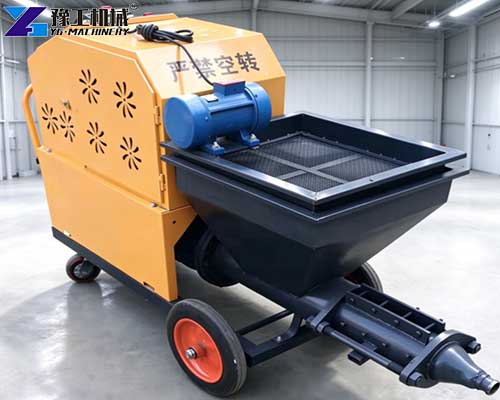
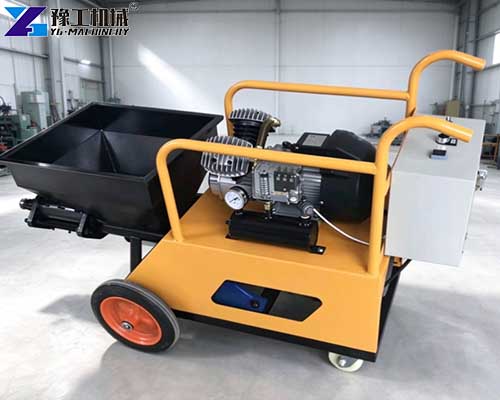
A plaster spraying machine uses a high-pressure screw pump to push mixed mortar through a delivery hose and spray it directly onto walls. Unlike traditional manual troweling or air-compressor systems, this equipment ensures a steady, continuous flow of material.
However, many buyers get confused by different technologies. Understanding the working principle of this machine helps you avoid buying the wrong equipment for your site. A basic misunderstanding often leads to costly downtime, severe material waste, and delayed schedules.
TL;DR: Our airless plaster spraying machine eliminates the need for an external air compressor. It delivers up to 6 MPa of pressure and covers up to 150 m²/h. For standard cement, use the YG318 (7.5kW, ≤12mm aggregate). For thick slurries, use the YG711 (6 MPa, built-in mixer). Always filter your sand to match the model’s particle limit.
Why Traditional Air-Assisted Machines Fail as a Plaster Sprayer
Traditional air-assisted systems rely on an air compressor to blow the mortar onto the wall. This method creates a massive cloud of dust. Therefore, a large amount of mortar bounces off the wall and lands on the floor. If you use this method instead of an airless plaster sprayer, you lose up to 20% of your material. On a large project, this waste cuts deeply into your profit margins.
Furthermore, air-assisted systems require you to buy and maintain an external air compressor. This extra machine consumes fuel, generates noise, and takes up truck space. Consequently, the operational costs increase drastically.
The Core Advantage of Airless Fluid Dynamics
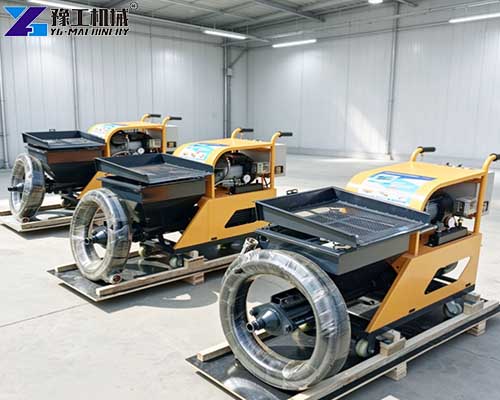
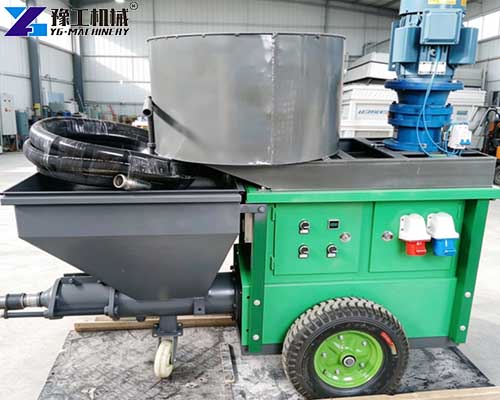
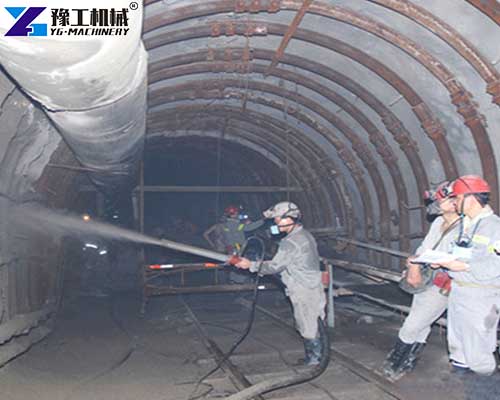
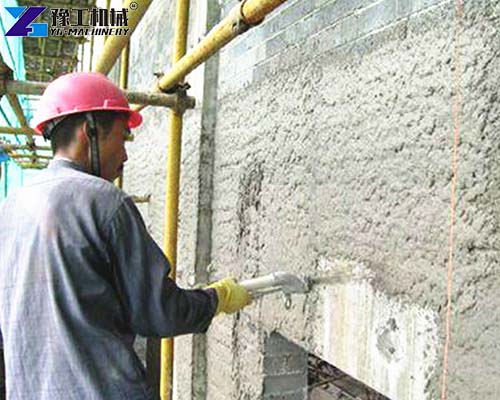
Our plaster spraying machine operates as a true airless system. The electric motor or diesel engine drives a high-torque screw pump. This pump generates working pressures up to 6 MPa, forcing the thick mortar directly into the wall surface. As a result, the material adheres tightly with minimal bounce-back waste. You keep the mortar on the wall, not on the floor.
How the Screw Pump Works
The screw pump features a precise rotor and stator design. As the rotor turns inside the rubber stator, it creates sealed cavities. Meanwhile, these cavities move the mortar continuously from the hopper to the hose. This continuous flow prevents the material from separating. Moreover, it keeps the pressure steady, which is crucial for a uniform coating thickness. A reliable plaster sprayer must maintain this steady pressure to avoid pulsing.
Matching the Right Model to Your Material
A screw pump handles thick slurries efficiently. However, you must control the aggregate size. If your sand contains larger stones than your model’s limit, it will clog the hose.
- YG311: Handles particles up to 3mm.
- YG318: Handles particles up to 12mm.
- YG511 & YG711: Handle particles up to 8mm.
Consequently, always use a screen to filter your sand before mixing. This simple step prevents 90% of site blockages on any plaster spraying machine.
How to Mix Mortar for Smooth Pumping
Correct water-to-cement ratios keep the fluid moving. We recommend a ratio of 0.7 to 1:1:3 (water:ash:sand). Meanwhile, operators must maintain a steady feeding pace into the 60L to 100L hopper. If the mixture becomes too thick, the pressure will spike, and the motor will strain. If it becomes too thin, the mortar will lose adhesion and slide off the wall.
Choosing the Right Equipment for Your Site
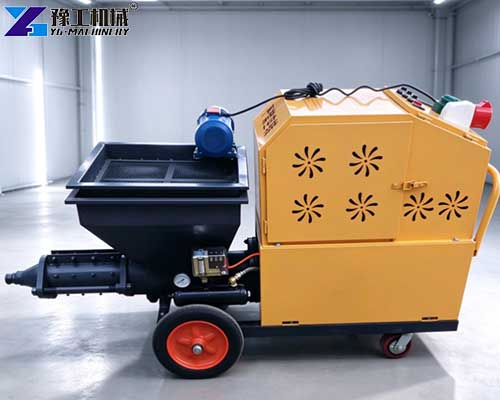
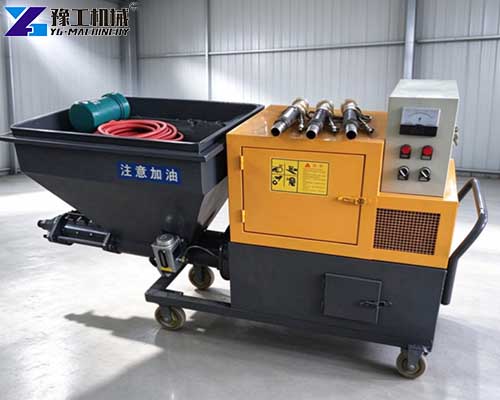
Different projects require different power configurations. Therefore, you must evaluate your site conditions before purchasing.
| Parameter | YG311 | YG318 | YG511 | YG711 |
|---|---|---|---|---|
| Capacity | 2–3 m³/h | 3 m³/h | 3–4 m³/h | 3 m³/h |
| Working pressure | 3–6 MPa | 3 MPa | Max 3 MPa | 6 MPa |
| Material ratio | Cement: Sand=1:3 | Water:Ash:Sand=0.7–1:1:3 | Water:Ash:Sand=0.7–1:1:3 | Water:Ash:Sand=0.7–1:1:3 |
| Voltage | 380V/220V | 380V | Diesel engine | 220V |
| Motor power | 4 kW | 7.5 kW | 8 HP / 12 HP | 4 kW + 4 kW mixer |
| Air supply | 2 kW pump | 0.3 m³/min | 0.3 m³/min | 0.4 m³/min |
| Spraying area | 150 m²/h | — | — | — |
| Horizontal distance | — | 60 m | 50–60 m | 60 m |
| Vertical distance | — | 40 m | 30–40 m | 40 m |
| Hopper volume | — | 80 L | 80 L | 100 L |
| Max aggregate | ≤3 mm | ≤12 mm | ≤8 mm | ≤8 mm |
| Feeding pipe | — | 32 mm | 32 mm | 32 mm |
| Total weight | — | 300 kg | 320 kg | 400 kg |
For Indoor and Standard Site Work: YG318
For indoor projects with stable electricity, the YG318 (380V, 7.5kW) or YG311 (4kW) electric models work perfectly. They provide quiet operation and zero emissions. The 80L hopper allows continuous spraying for medium-sized walls. This makes the YG318 an ideal spray machine for plastering interior walls and ceilings.
For Remote Sites Without Power: YG511
However, if your project is in a remote area without grid power, you need a diesel engine model. Our YG511 provides reliable power with an 8HP/12HP diesel engine in off-grid locations. For extremely high-viscosity materials, the YG711 offers a built-in mixer and 100L hopper, preventing the material from settling.
Why Continuous Flow Matters on Large Projects
Manual plastering creates uneven wall thickness, leading to hollowing and cracks later. Furthermore, relying on manual labor exposes your project to schedule delays.
Our YG311 system delivers a continuous flow at rates up to 150 m²/h. This steady output eliminates patches and reduces the need for secondary leveling. As a result, contractors save both time and labor costs. One operator using a plaster spraying machine can replace a team of three to four workers.
Customer Practical FAQ
A: The screw pump rotor and stator on the plaster sprayer will jam. Stop the machine immediately, reverse the pump slightly to release pressure, and clean the hose. Always filter your sand.
A: The machine delivers up to 6 MPa of pressure (YG711), supporting horizontal distances of 50m to 60m and vertical distances up to 40m. For extreme high-rise projects, please consult our engineering team.
A: Cleaning a spray machine for plastering takes about 10 to 15 minutes. Run clean water through the hopper and hose until the water runs clear. Remove the nozzle and soak it in water.
A: Yes. This plaster spraying machine handles various water-based slurries, including cement mortar, gypsum, putty, and fireproof coatings. Different nozzle sizes adjust the spray pattern.
Factory Supply & Contact
We engineer this equipment for heavy-duty site conditions. Do not let material bounce-back and manual labor costs eat your profits. Contact our YG sales team for a detailed quote and ROI calculation based on your daily project scale.