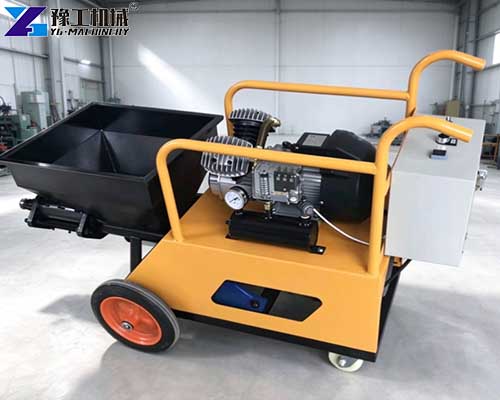
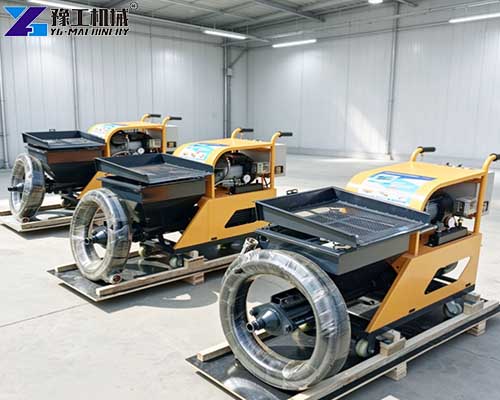
A plaster sprayer that runs on air pressure wastes material before the mortar ever reaches the wall. Air-assisted units atomize the mix with compressed air, and that air stream throws a portion of the material past the wall surface as bounce-back. Airless designs push mortar through a hose under pump pressure and deposit it directly on the substrate. Therefore, contractors comparing material loss per square meter should look at how the sprayer delivers material, not only at its output rating. Our engineering team builds airless units that hold steady pressure at the nozzle, which keeps the mix on the wall instead of on the floor.
TL;DR: Air-assisted sprayers need a separate compressor, burn extra fuel, and lose material to air-driven bounce-back. Airless sprayers push mortar directly with pump pressure and waste less on every wall. The YG311 reaches a spraying area of up to 150 m²/h within its 3–6 MPa working pressure range.
| Parameter | YG311 | YG318 | YG511 | YG711 |
|---|---|---|---|---|
| Capacity | 2–3 m³/h | 3 m³/h | 3–4 m³/h | 3 m³/h |
| Working pressure | 3–6 MPa | 3 MPa | Max 3 MPa | 6 MPa |
| Material ratio | Cement: Sand=1:3 | Water:Ash:Sand=0.7–1:1:3 | Water:Ash:Sand=0.7–1:1:3 | Water:Ash:Sand=0.7–1:1:3 |
| Voltage | 380V/220V | 380V | Diesel engine | 220V |
| Motor power | 4 kW | 7.5 kW | 8 HP / 12 HP | 4 kW + 4 kW mixer |
| Air supply | 2 kW pump | 0.3 m³/min | 0.3 m³/min | 0.4 m³/min |
| Spraying area | 150 m²/h | — | — | — |
| Horizontal distance | — | 60 m | 50–60 m | 60 m |
| Vertical distance | — | 40 m | 30–40 m | 40 m |
| Hopper volume | — | 80 L | 80 L | 100 L |
| Max aggregate | ≤3 mm | ≤12 mm | ≤8 mm | ≤8 mm |
| Feeding pipe | — | 32 mm | 32 mm | 32 mm |
| Total weight | — | 300 kg | 320 kg | 400 kg |
Air-Assisted vs. Airless Delivery: How Each Plaster Sprayer Moves Material
Air-assisted units combine a material pump with a compressed-air stream. The air breaks the mortar into a finer pattern and helps it spread across the wall. However, that same air stream also throws material outward, and the portion that misses the wall falls as bounce-back. The compressor adds fuel consumption, maintenance, and a second machine to move between floors.
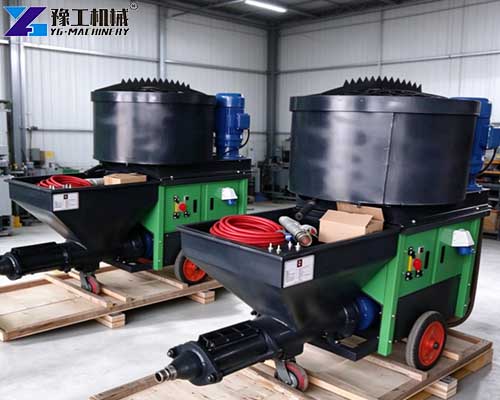
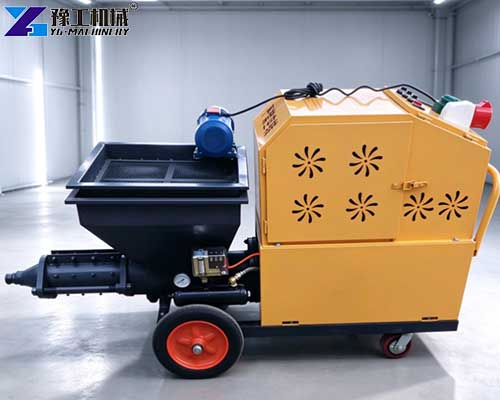
Airless units remove the compressor entirely. The pump pushes mortar through the hose at working pressure, and the nozzle shapes the pattern without air. Consequently, material leaves the gun with enough velocity to adhere but not enough to ricochet. The pump does the work that the compressor would otherwise do, which simplifies the equipment list and reduces the number of failure points on site.
Why Air-Driven Bounce-Back Costs More Than It Looks
Bounce-back looks like a small loss on a single wall. Across a full floor, it becomes a material and cleanup problem. The fallen mortar must be swept up, removed, and replaced with fresh mix to finish the wall. Meanwhile, the compressor keeps running on fuel or electricity even when the crew pauses to reposition scaffolding. Those costs do not appear on the specification sheet, but they show up on the project budget.
Material Loss and the Case for Plaster Spraying Equipment Without Air
A plastering spray machine setup that relies on air adds cost at three points: the compressor itself, the fuel or power it consumes, and the material lost to bounce-back. Airless equipment removes the compressor and the fuel line, which cuts both capital and operating costs. The remaining question is whether pump pressure alone can deliver mortar at a rate that matches manual output.
The YG311 answers that question within its 3–6 MPa working pressure range. It reaches a spraying area of up to 150 m²/h under proper site conditions, which matches a five-person manual crew’s daily output in roughly one working hour. Meanwhile, the YG711 holds 6 MPa at the nozzle because the screw pump maintains a constant compression ratio across the rotor and stator. Cheaper airless units lose pressure as the hose heats up, and the spray pattern widens mid-pass. That pressure drop is why some contractors still see bounce-back even without air. The YG711 also reaches 60 m horizontally and 40 m vertically, so crews on upper floors keep the same spray quality without relocating the pump.
Pressure, Pattern, and Why a Plastering Spray Machine Holds Material on the Wall
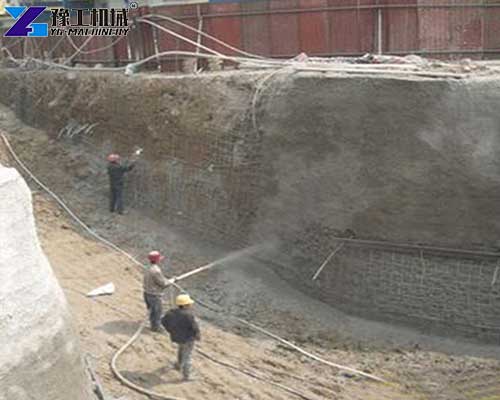
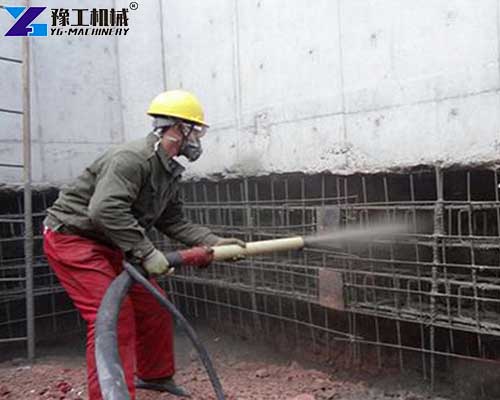
A plaster spraying equipment deposits material with pump pressure rather than air velocity. The difference matters at the wall surface. Air-driven patterns spread material thin and rely on air speed to carry it across the gap, and that speed is exactly what sends a portion of the mix past the target. Pump-driven patterns deliver a denser stream that compacts against the wall as it lands.
Matching Pressure to Wall Texture
Different wall surfaces need different delivery. A rough concrete face absorbs material quickly and benefits from a slightly wider pattern and higher flow. A smooth block wall needs a tighter pattern and lower flow to avoid running. Operators adjust flow at the gun without stopping the pump, which keeps the spray continuous and avoids cold joints. A cold joint forms where one pass ends and the next begins, and it becomes a weak line that cracks under thermal movement.
Quick-Release Clamps as a Structural Advantage of Plaster Sprayer
Airless systems simplify the equipment list, but they still require daily flushing. Mortar left in the hose or pump chamber hardens overnight and blocks the line on the next start. Most airless units bolt the pump chamber shut, and a clog means tools, downtime, and a crew standing idle. Our quick-release clamps let one technician open the chamber by hand, clear the obstruction, and resume spraying within minutes. The full flush cycle takes approximately ten minutes and eliminates the most common cause of morning downtime.
Customer Practical FAQ for Plaster Spraying Equipment
Contractors comparing airless and air-assisted systems ask about compressor cost, material waste, pressure limits, and what separates one airless unit from another. The answers below come from our engineering team’s field experience.
A: Airless and air-assisted systems use different gun and nozzle designs, so adding a compressor to an airless unit does not produce the same result. The pump, hose, and gun work as a matched set. If you need a finer pattern for a specific finish, adjust flow at the gun or change the nozzle rather than adding air equipment that the machine was not built to use.
A: Airless delivery handles thick mortar as long as the mix stays within the 0.7–1:1:3 water-cement-sand ratio. The YG711 delivers 6 MPa working pressure, which keeps dense mixes moving through the hose without stalling. However, a mix that runs too dry increases friction in the pump chamber and risks a blockage. Keep the ratio within range, and the pump maintains steady flow.
A: Three things show up in daily use. The screw pump holds working pressure at the nozzle instead of fading as the hose heats. The quick-release clamps let a crew clear a blockage without tools. And the model range covers aggregate limits from 3 mm to 12 mm, so the machine matches the sand supply instead of forcing the crew to pre-screen everything. Contact our engineering team for custom voltage configurations and site layout advice if your site conditions fall outside the standard range.
A: The YG311 operates within a 3–6 MPa working pressure range, and its spraying area reaches up to 150 m²/h under proper site conditions. Output depends on mix consistency, hose length, and operator technique, not on pressure alone. Contact our engineering team for custom voltage configurations and site layout advice if your project involves long hose runs or unusual wall textures.
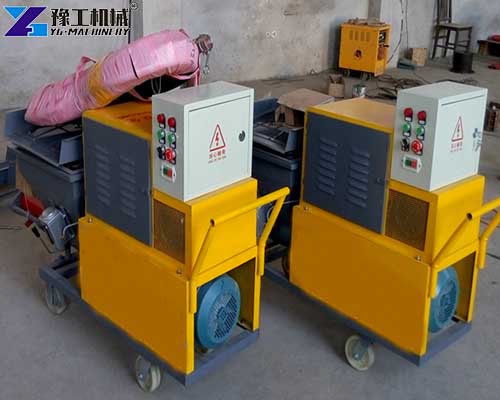
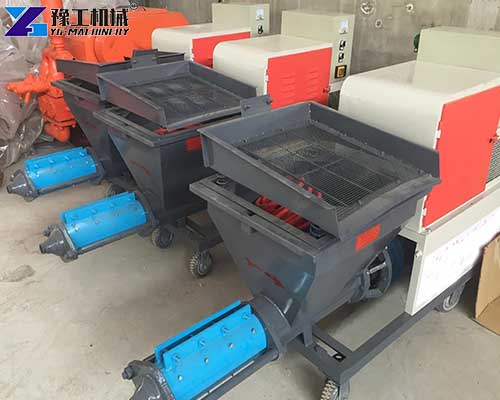
Factory Supply & Contact for Plastering Spray Machine
We build airless plaster sprayers for contractors who want material on the wall, not on the floor. Every model in the range removes the compressor from the equipment list, which cuts fuel costs, maintenance, and air-driven bounce-back at the same time. Contact our sales team for a detailed quote and ROI calculation based on your daily project scale. Send your wall type, finish requirement, and power availability, and our YG engineers will confirm which airless configuration fits your site.